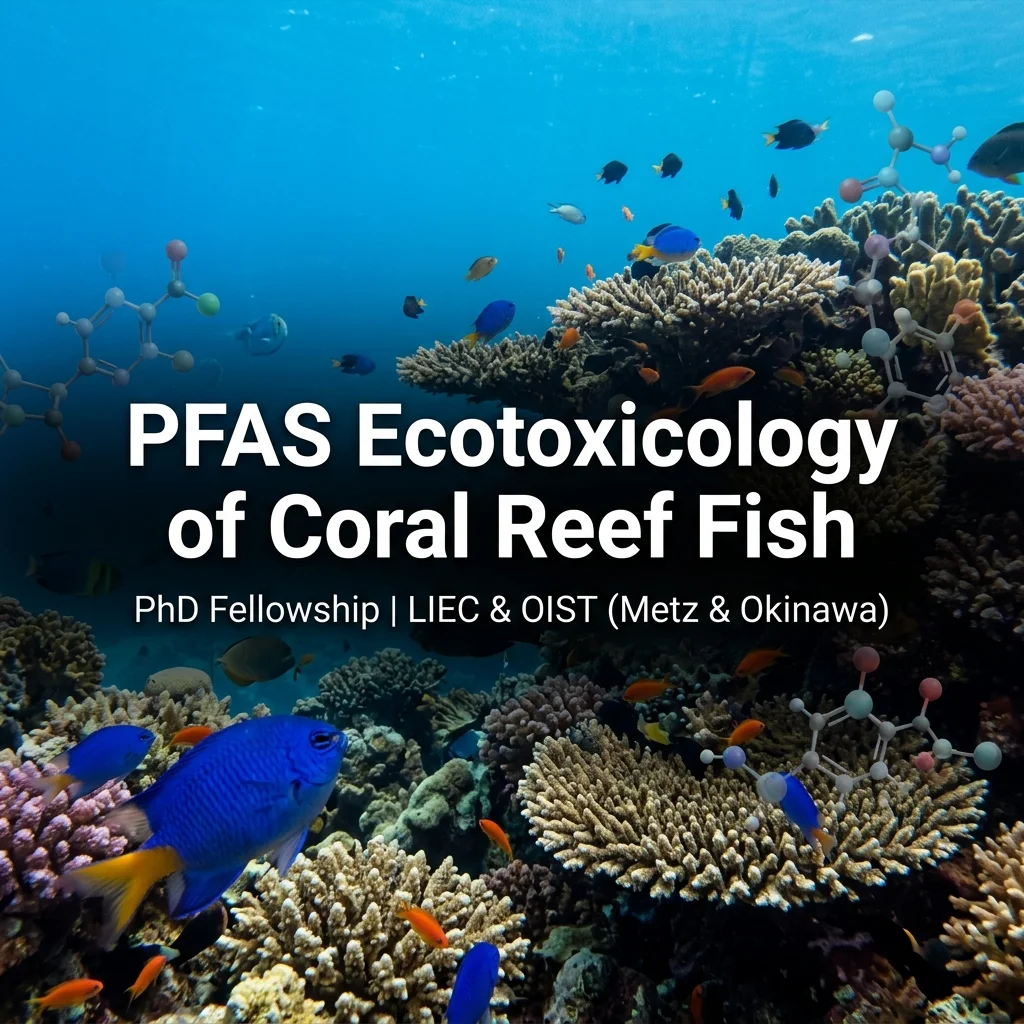
A fully funded 3-year PhD Fellowship is available in environmental ecotoxicology to investigate the impacts of Per- and Polyfluoroalkyl Substances (PFAS) on coral reef ecosystems. This project is a collaborative effort between the Laboratoire Interdisciplinaire des Environnements Continentaux (LIEC) in Metz, France, and the CNRS-OIST International Research Laboratory “EARLY” at the Okinawa Institute of Science and Technology (OIST) in Japan.
Project Overview
PFAS (often referred to as “forever chemicals”) are a group of synthetic organofluorine compounds widely used in industrial and consumer products. Due to their extreme persistence and bioaccumulative nature, they represent a significant environmental threat to aquatic life. This research project focuses on the ecotoxicology of PFAS in a reef environment, using the coastal blue damselfish (Chrysiptera cyanea) in Okinawa as a model organism. The study will employ a transcriptomic coupling approach, field ecology, controlled laboratory bioassays, and dose-response modeling to characterize adverse outcome pathways (AOPs).
Key Responsibilities
- Conduct field sampling and ecological observations of coral reef fish in Okinawa, Japan.
- Perform controlled laboratory exposure bioassays to evaluate the biological effects of PFAS on damselfish.
- Generate and analyze transcriptomic datasets to understand molecular and metabolic pathway disruptions.
- Apply dose-response and ecotoxicological models to characterize adverse outcomes.
- Write scientific papers, prepare progress reports, and present findings at international conferences.
Position Structure and Funding
- Duration: 3 years (fully funded).
- Location: The PhD candidate will be primarily based at LIEC in Metz, France, with extended research stays (typically 3 to 6 months per year) at OIST in Okinawa, Japan.
- Supervision: Co-supervised by Professor Vincent Laudet (OIST, Director of the EARLY Laboratory) and researchers from LIEC (Elise Billoir and Sophie Prud’homme).
Eligibility and Qualifications
- A Master’s degree (or equivalent) in Life Sciences, Environmental Toxicology, Marine Sciences, Ecology/Evolution, or Molecular Biology/Bioinformatics.
- Strong interest or experience in molecular biology techniques, transcriptomics, and bioinformatics.
- Familiarity with statistical analysis and ecotoxicological modeling (preferably in R) is an advantage.
- Excellent communication skills in English and ability to work in multicultural, international environments.
- Openness to travel and split research time between France and Japan.
How to Apply
Interested candidates must submit their application (including a CV, cover letter outlining research interests, academic transcripts, and contact information for two references) through the official CNRS employment portal. The application deadline is June 27, 2026.