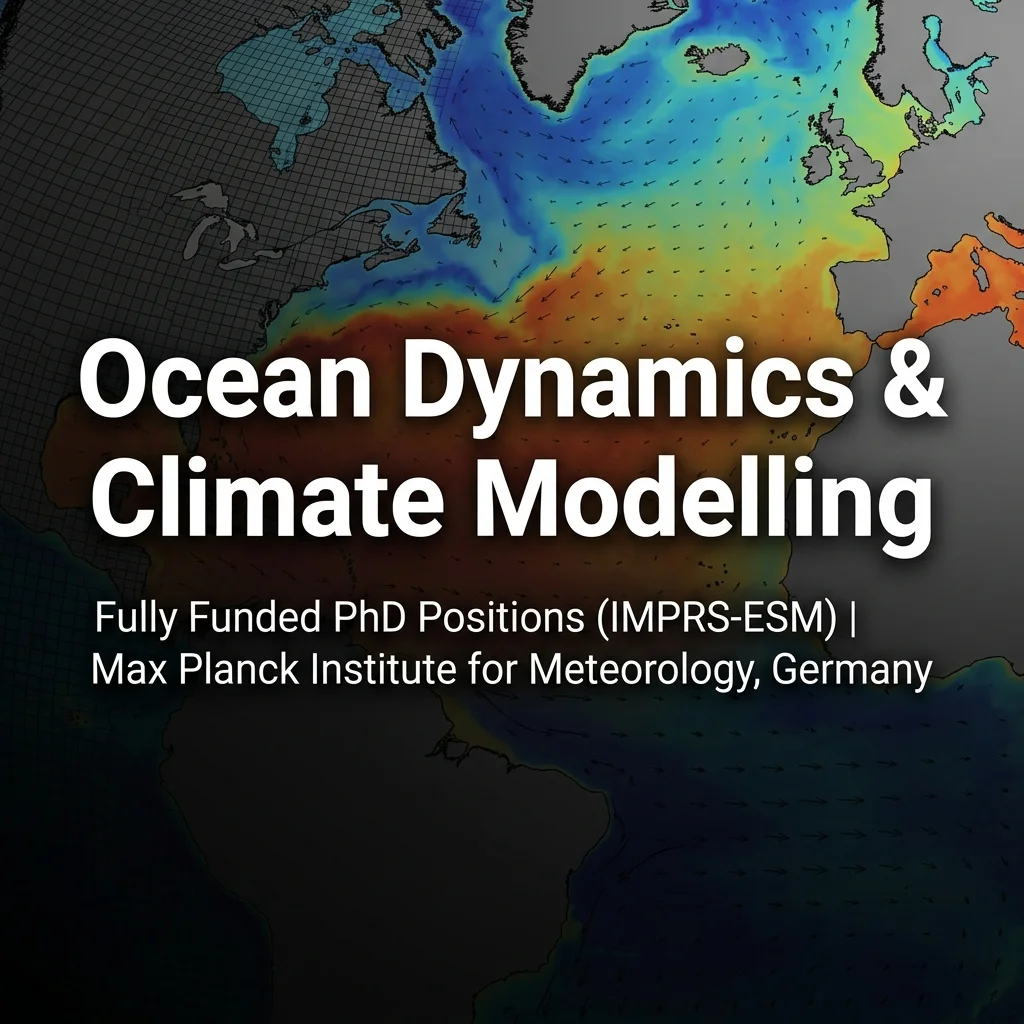
The International Max Planck Research School on Earth System Modelling (IMPRS-ESM) is now accepting applications for its 2027 PhD intake in Hamburg, Germany. Jointly operated by the Max Planck Institute for Meteorology (MPI-M) and Universität Hamburg, the program offers fully funded three-year doctoral positions in oceanography, climate modeling, and marine climate dynamics.
IMPRS-ESM Research Scope & Ocean Climate Modeling
Understanding ocean-atmosphere interactions, deep ocean circulation, marine biogeochemical cycles, and polar sea-ice dynamics is central to predicting global climate change. Doctoral students at IMPRS-ESM engage in cutting-edge computational modeling and observational analysis. Core marine and climate research topics include:
- Physical Oceanography & Ocean Dynamics: Modeling North Atlantic circulation, heat uptake, wind-driven gyres, and mesoscale ocean eddies.
- Marine Biogeochemistry & Carbon Cycling: Simulating ocean carbon pumps, ocean acidification, oxygen minimum zones, and marine ecosystem responses.
- Sea Ice & Polar Oceans: Investigating Arctic and Antarctic sea-ice melt dynamics, atmosphere-ice-ocean feedbacks, and polar ecosystem shifts.
- Climate Prediction & Earth System Models: Developing and refining high-resolution Earth system models (e.g., ICON-ESM) for multi-decadal climate projections.
Stipend & Doctoral Benefits
- Fully Funded Position: Financial support of approximately €2,150 per month for 3 years.
- No Tuition Fees: Students only pay the standard university semester contribution (which includes public transit passes).
- Supervision & Training: Access to high-performance supercomputing facilities (e.g., DKRZ German Climate Computing Centre), structured mentoring, and international conference travel grants.
- Location: Based in Hamburg, Germany—a premier global hub for marine and climate sciences.
Eligibility Requirements
- Hold or be near completion of a Master’s degree (with a written thesis) in Oceanography, Meteorology, Atmospheric Science, Physics, Environmental Physics, Applied Mathematics, Computer Science, or related quantitative sciences.
- Solid background in numerical modeling, scientific programming (Python, Fortran, C++, or R), or data analysis of large environmental datasets.
- High motivation for interdisciplinary scientific research and proficiency in spoken and written English.
Application Deadline & How to Apply
Applications must be submitted online through the official IMPRS-ESM recruitment portal by 15 September 2026. Selection interviews will take place in late November 2026, with accepted students commencing their doctoral studies from March 2027 onwards.