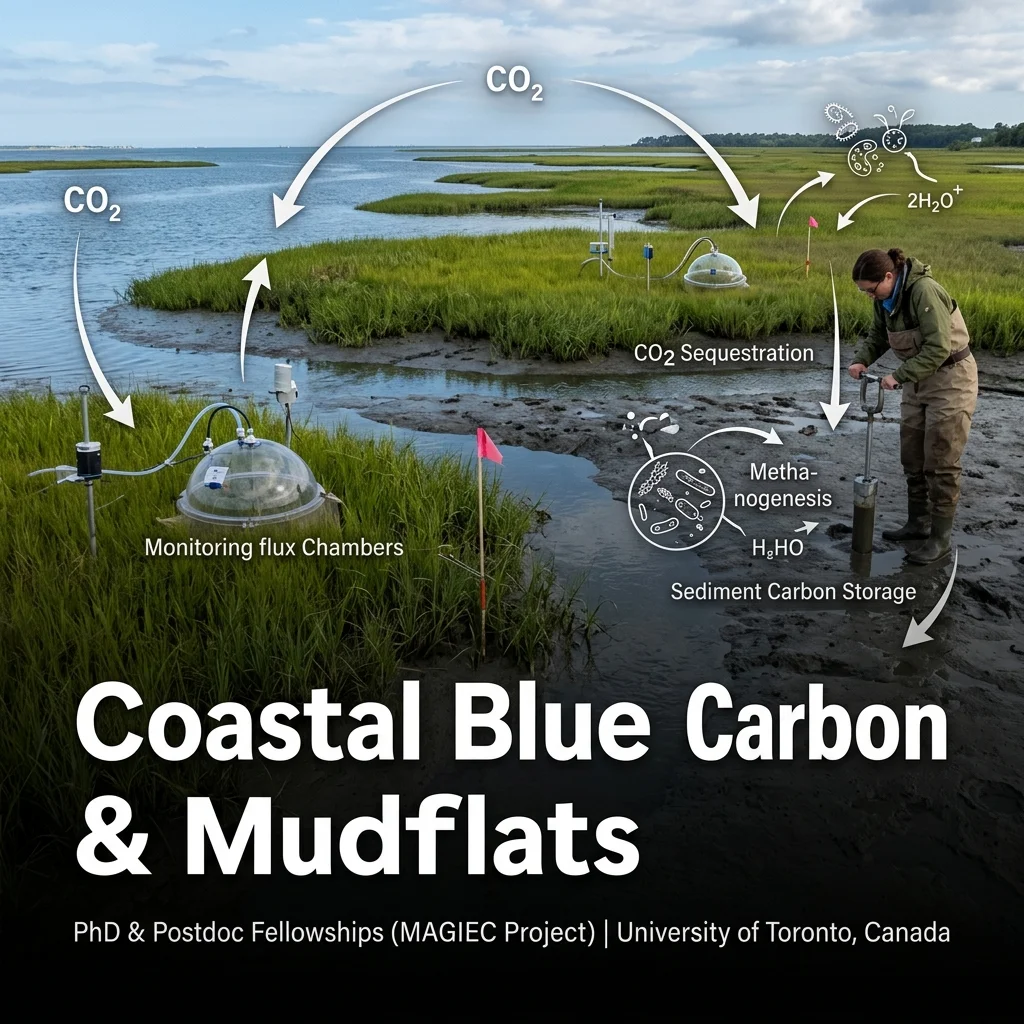
The Biogeochemistry Research Group at the University of Toronto, led by Prof. Maria Dittrich, is inviting applications for two fully funded positions: One Postdoctoral Fellow and One PhD Student. These positions are part of the newly launched international research consortium MAGIEC (Mudflats Across Gradients of Human Impact and Environmental Extremes: Blue Carbon Dynamics), bridging research institutions across Canada, Ireland, and Poland.
MAGIEC Project & Blue Carbon Research Scope
Coastal mudflats and intertidal wetlands serve as vital blue carbon ecosystems, sequestering carbon at rates significantly higher per unit area than terrestrial forests. However, these environments face severe pressures from climate extremes and coastal human development. The MAGIEC project investigates how environmental gradients, extreme weather events, and anthropogenic stressors influence:
- Carbon cycling and long-term organic carbon burial in intertidal mudflats.
- Greenhouse gas (CO2, CH4, N2O) flux dynamics across coastal sediment-water interfaces.
- Microbial metabolic processes, mineral-microbe interactions, and nutrient transformations.
- Ecosystem resilience and coastal management strategies for blue carbon preservation.
Position Roles & Key Responsibilities
1. Postdoctoral Fellow
- Lead field sampling campaigns across coastal intertidal mudflats.
- Conduct high-resolution biogeochemical analysis of sediment cores, porewater chemistry, and microbial communities.
- Apply advanced analytical techniques (e.g., spectroscopy, stable isotope probing, microelectrode profiling) to quantify carbon turnover rates.
- Supervise graduate students and publish high-impact peer-reviewed manuscripts.
2. Doctoral Student (PhD Candidate)
- Conduct field experiments and laboratory incubations measuring gas exchange and mineral-organic interactions.
- Characterize microbial community dynamics responsible for carbon and nitrogen cycling in mudflat sediments.
- Participate in international project meetings and present research findings at international marine biogeochemistry conferences.
Eligibility & Desirable Skills
- Qualifications: M.Sc. (for PhD applicants) or Ph.D. (for Postdoc applicants) in Marine Biogeochemistry, Aquatic Science, Environmental Chemistry, Microbial Ecology, Oceanography, or related fields.
- Strong background in sediment chemistry, aquatic carbon cycling, or analytical geochemistry.
- Experience with field sampling in coastal, estuarine, or wetland habitats.
- Excellent written and oral communication skills in English.
How to Apply
Interested candidates should submit a complete application package (Cover Letter outlining research interests, CV, academic transcripts, and contact details for three academic references) directly to Prof. Maria Dittrich (University of Toronto). Applications will be evaluated on a rolling basis until the positions are filled.