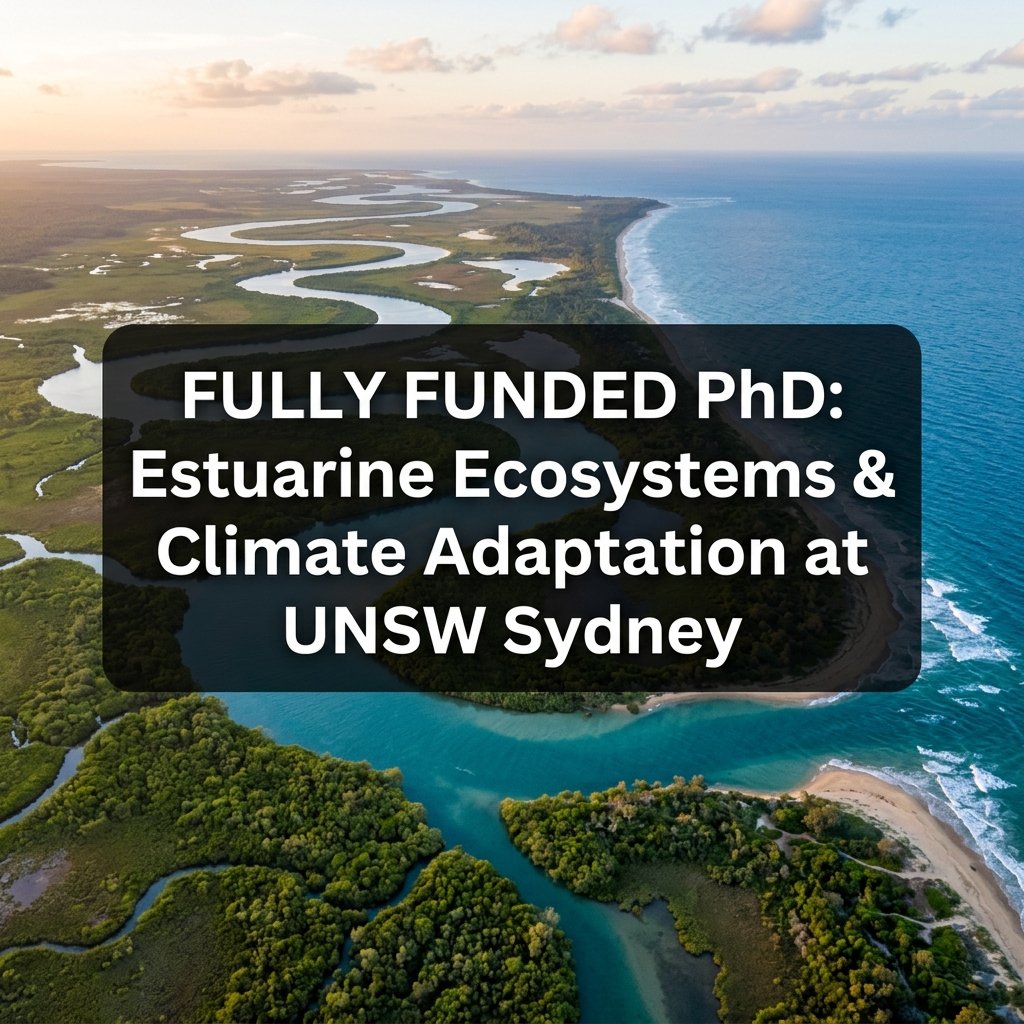
Are you passionate about coastal ecosystems, climate resilience, and science-driven environmental management? A fully funded PhD opportunity is now available at UNSW Sydney as part of a multidisciplinary collaboration between UNSW Science and UNSW Engineering. This project brings together leading researchers in ecology, engineering, and climate science to explore how estuarine systems respond to environmental pressures and human impacts. This is an exceptional opportunity for candidates interested in climate adaptation, ecosystem services, and sustainable coastal management.
Estuaries are among the most productive and valuable ecosystems on Earth. They provide coastal protection, fisheries and food security, carbon storage, biodiversity habitat, water filtration, and nutrient cycling. However, these systems face growing pressures from climate change, sea-level rise, urban development, and altered catchment processes. This PhD will investigate how estuarine ecosystems respond to both climatic and anthropogenic stressors and how science can guide effective adaptation strategies.
Research Themes & Collaboration
The project offers flexibility depending on the candidate’s expertise and interests. Potential research themes include:
- Assessing estuarine ecosystem services and habitat connectivity.
- Understanding climate-driven and human-induced pressures.
- Investigating cumulative and compounding environmental impacts.
- Developing adaptation strategies and nature-based solutions.
- Linking ecological function to coastal engineering design.
- Supporting catchment-to-coast planning frameworks.
This PhD includes close collaboration with the NSW Department of Climate Change, Energy, the Environment and Water (DCCEEW). This partnership ensures that research outcomes directly inform climate adaptation policy, coastal and estuary management, catchment planning, and nature-based infrastructure solutions. Working with a government agency provides candidates with industry exposure and applied research pathways beyond academia.
Funding and Scholarships
Competitive scholarships are available for high-achieving candidates. Funding may include:
- Full tuition fee coverage.
- Living stipend (aligned with Australian Research Training Program standards).
- Potential top-up scholarships.
- Paid industry engagement opportunities.
Candidate Profile
Applicants should meet the following criteria:
- A strong academic background in ecology, environmental science, coastal engineering, marine science, climate science, or related fields.
- Interest in interdisciplinary research.
- Quantitative, modelling, or field-based research skills (experience in ecosystem modelling, GIS, or coastal processes is highly encouraged).
- Strong written and verbal English communication.
How to Apply
Interested applicants should email the contacts with the subject line PhD Estuaries. Please include your CV, academic transcripts, and a brief statement of research interests. Early contact is encouraged to discuss project fit and scholarship options.
Frequently Asked Questions
1. Is this PhD fully funded?
Yes. Competitive scholarships are available, and successful candidates may receive full tuition coverage and stipend support.
2. Can international students apply?
Yes, high-achieving domestic and international candidates are encouraged to apply.
3. What disciplines are suitable?
Ecology, marine science, environmental engineering, coastal science, climate science, GIS, and related fields.
4. Is industry collaboration included?
Yes. The project collaborates with the NSW Department of Climate Change, Energy, the Environment and Water.
5. Where is the PhD based?
At UNSW in Sydney, Australia.
6. What are nature-based solutions?
Nature-based solutions use ecosystem processes—such as wetland restoration or mangrove protection—to reduce climate risks and improve environmental resilience.