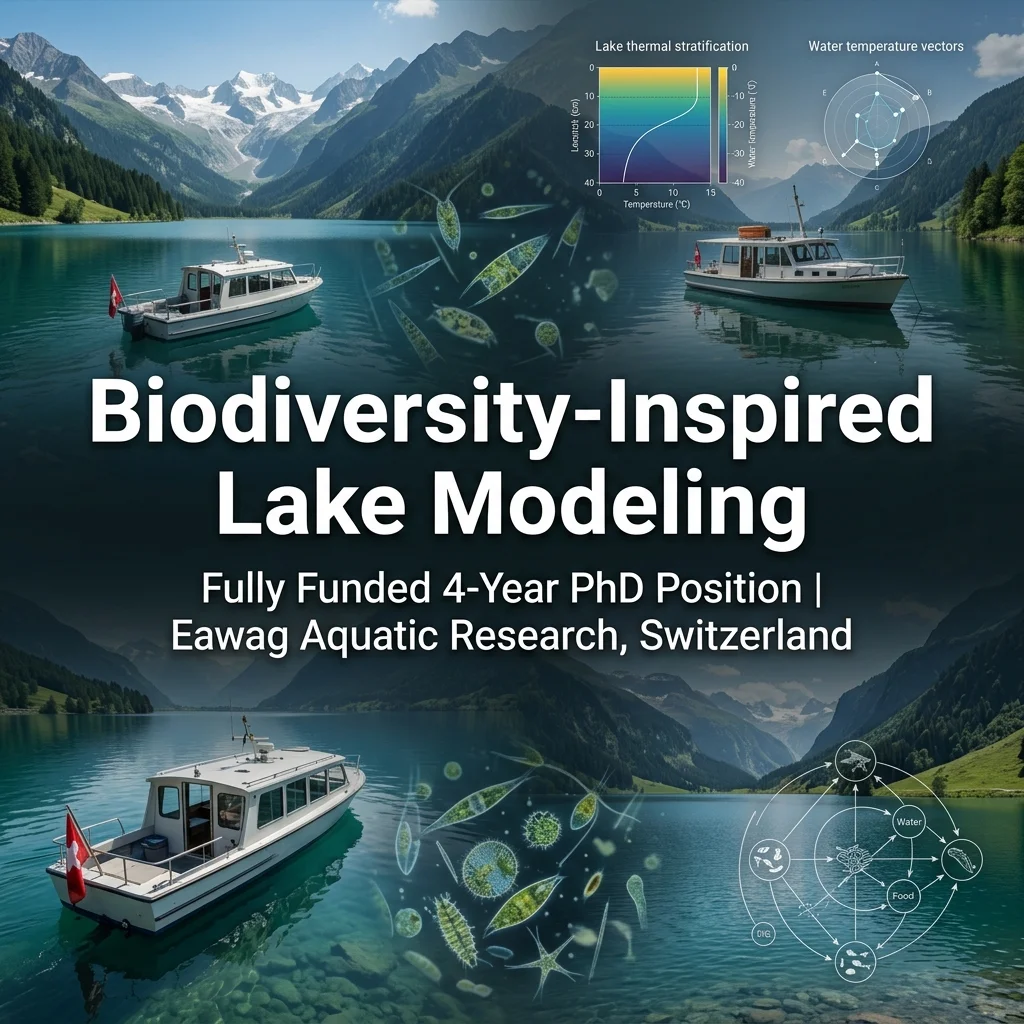
Eawag (Swiss Federal Institute of Aquatic Science and Technology) is inviting applications for a fully funded 4-year Ph.D. Position in Biodiversity-Inspired Lake Modeling within its Aquatic Ecology Department in Dübendorf, Zurich, Switzerland.
Research Focus & Limnology Scope
Freshwater lakes face mounting environmental stress from climate-driven thermal stratification, warming temperatures, and nutrient shifts. This doctoral research project investigates how lake biodiversity alters ecosystem-scale functioning and climate resilience:
- Mechanistic Lake Ecosystem Modeling: Developing trait-based computational models linking phytoplankton physiology, nutrient uptake kinetics, and thermal stratification.
- Experimental Phytoplankton Trait Ecology: Conducting controlled laboratory experiments to measure growth rates, light adaptation, and nutrient stoichiometry under warming scenarios.
- Limnological Predictions: Connecting cellular-level physiological traits with lake-wide water quality, primary production, and biodiversity dynamics.
Funding Package & Contract Terms
- Host Institution: Eawag Aquatic Ecology Department (Biodiversity & Ecosystem Functioning group), Dübendorf (Zurich), Switzerland.
- Funding: 100% Fully funded 4-year doctoral contract under Swiss National Science Foundation guidelines.
- Target Start Date: Up to 1 December 2026.
Candidate Requirements
- Master’s degree (M.Sc.) in Aquatic Ecology, Limnology, Computational Biology, Environmental Sciences, or related fields.
- Experience or strong interest in ecological modeling, numerical programming (R, Python, or Julia), and phytoplankton biology.
- Fluency in spoken and written English.
How to Apply
Applications must be submitted through Eawag’s online job portal. Required documents include a letter of motivation, CV, academic transcripts, contact details for two referees, and a brief summary of the M.Sc. thesis.