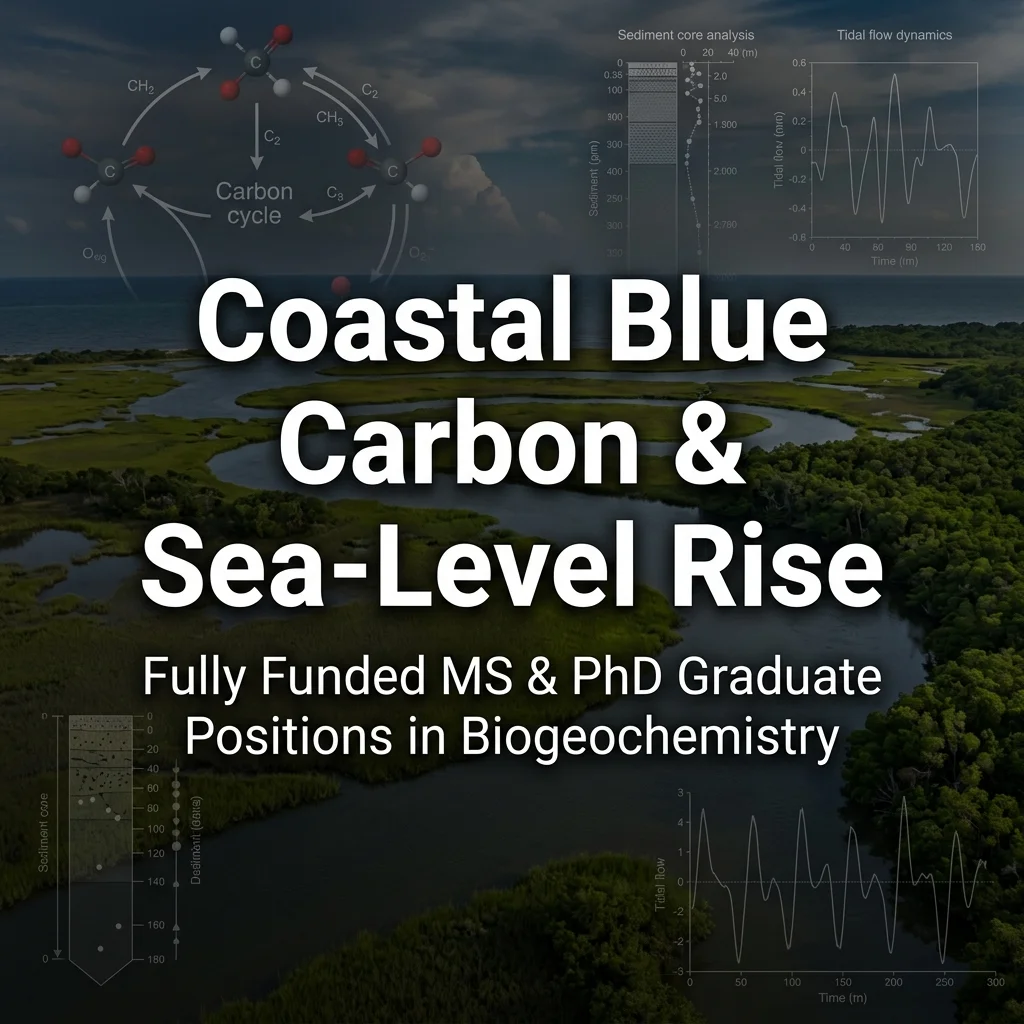
Applications are invited for fully funded Master’s (M.S.) and Doctoral (Ph.D.) Graduate Research Assistantships in Coastal Blue Carbon, Sea-Level Rise, and Biogeochemical Cycling commencing in the upcoming academic cycle.
Research Focus & Marine/Estuarine Biogeochemistry Scope
Coastal wetlands, salt marshes, and estuarine ecosystems serve as major global carbon sinks—commonly termed Blue Carbon—while remaining highly vulnerable to climate change and rising sea levels. This graduate research program combines field sampling, laboratory biogeochemistry, and greenhouse experiments to investigate:
- Coastal Blue Carbon Dynamics: Quantifying carbon sequestration, soil organic matter burial rates, and greenhouse gas fluxes (CO2, CH4) in tidal wetlands.
- Sea-Level Rise & Saltwater Intrusion: Evaluating how rising sea levels alter estuarine biogeochemical cycles, microbial community function, and sediment stability.
- Interdisciplinary Biogeochemistry: Combining field measurements, soil chemistry, greenhouse gas chromatography, and spatial modeling.
Funding & Graduate Package
- Degrees: M.S. and Ph.D. in Environmental Science, Geology, Marine Science, or Biogeochemistry.
- Funding: Full tuition waiver, monthly stipend, and research support for field/laboratory equipment.
- Eligibility: Open to domestic and international applicants with backgrounds in geology, environmental science, biology, chemistry, or soil science.
Required Candidate Profile
- Bachelor’s or Master’s degree in Environmental Science, Marine Biology, Chemistry, Geology, Soil Science, or related quantitative disciplines.
- Enthusiasm for field research in coastal/estuarine environments and laboratory analytical procedures.
- Strong analytical, quantitative, and scientific writing abilities.
How to Apply
Interested candidates should submit a cover letter describing research interests, detailed CV, university transcripts, and contact details for three professional references to the principal investigator via the official laboratory recruitment portal.