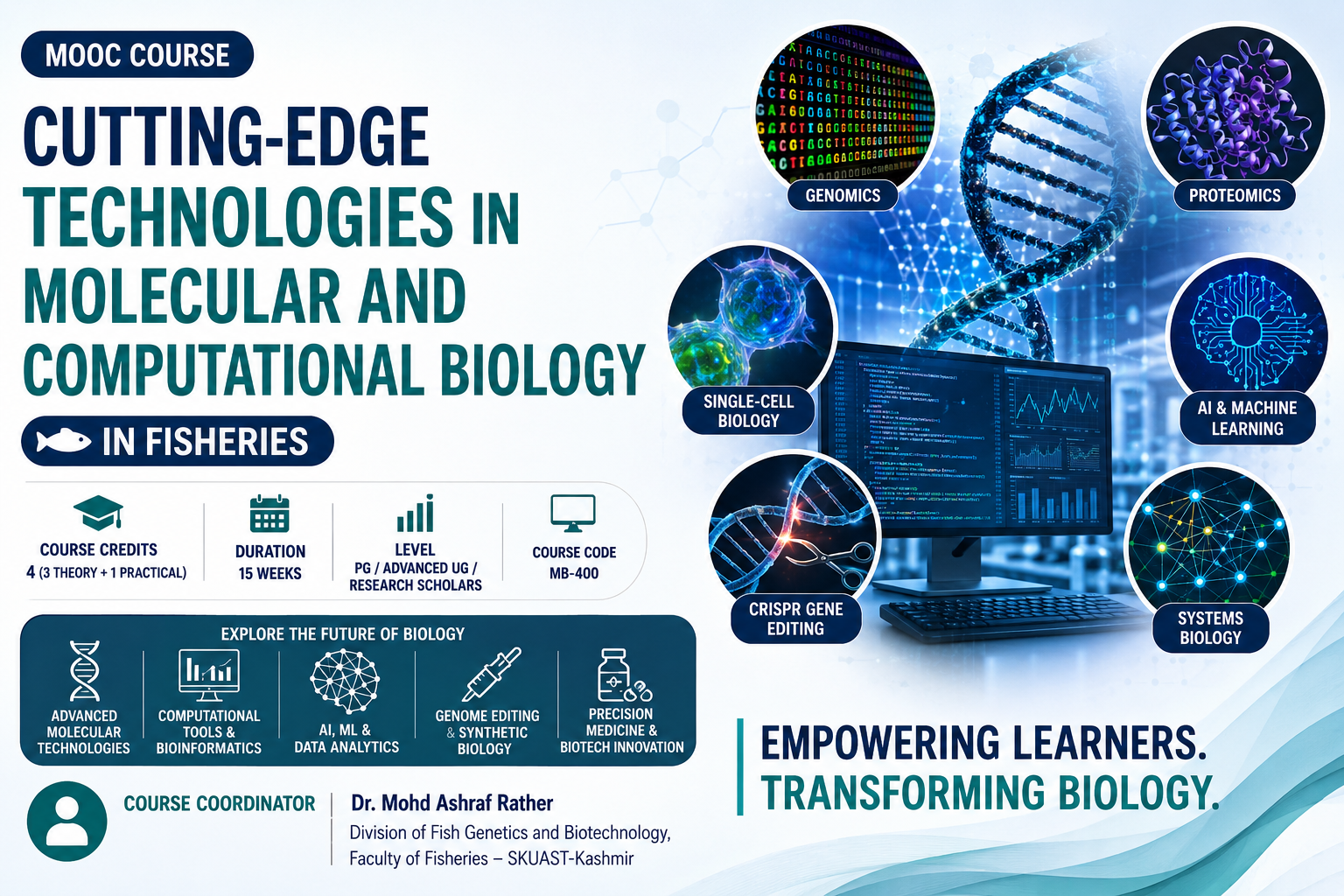
Course Credits: 4 (3 Theory + 1 Practical)
Duration: 15 Weeks
MB-400
Level: PG/Advanced UG/Research Scholars
Course Coordinator: Dr. Mohd Ashraf Rather,Division of Fish Genetics and Bitoechnolgy, Faculty of Fisheries-SKUAST-Kashmir
COURSE OVERVIEW
This course introduces emerging technologies transforming molecular and computational biology, including genomics, transcriptomics, proteomics, single-cell biology, CRISPR gene editing, artificial intelligence, machine learning, systems biology, bioinformatics, synthetic biology, and precision medicine.
COURSE OBJECTIVES
Upon completion, learners will be able to:
- Understand advanced molecular biology technologies.
- Analyze biological data using computational tools.
- Apply AI and machine learning in biological research.
- Interpret multi-omics datasets.
- Utilize genome editing and synthetic biology approaches.
- Design computational biology research projects.
COURSE OUTCOMES
Students will be able to:
- Perform biological data analysis.
- Interpret genomic and transcriptomic datasets.
- Apply computational tools in biological research.
- Evaluate emerging molecular technologies.
- Design innovative biotechnology solutions.

QUADRANT I: E-TUTORIAL
MODULE 1
Foundations of Molecular and Computational Biology
Lecture 1
Introduction to Molecular Biology
Lecture 2
Central Dogma of Biology
Lecture 3
DNA Replication Technologies
Lecture 4
Computational Biology Overview
Lecture 5
Current Research Trends
MODULE 2
Genomics and Next Generation Sequencing
Lecture 6
Human Genome Project
Lecture 7
Next Generation Sequencing (NGS)
Lecture 8
Third Generation Sequencing
Lecture 9
Nanopore Sequencing
Lecture 10
Genome Assembly
MODULE 3
Transcriptomics and Single Cell Technologies
Lecture 11
RNA Sequencing
Lecture 12
Single Cell RNA Sequencing
Lecture 13
Spatial Transcriptomics
Lecture 14
Gene Expression Analysis
Lecture 15
Transcriptome Databases
MODULE 4
Proteomics and Metabolomics
Lecture 16
Protein Structure Prediction
Lecture 17
Mass Spectrometry
Lecture 18
Metabolomics Platforms
Lecture 19
Protein Networks
Lecture 20
Multi-Omics Integration
MODULE 5
CRISPR and Genome Editing
Lecture 21
CRISPR-Cas Systems
Lecture 22
Base Editing
Lecture 23
Prime Editing
Lecture 24
Gene Therapy
Lecture 25
Ethical Issues
MODULE 6
Artificial Intelligence in Biology
Lecture 26
Introduction to AI
Lecture 27
Machine Learning
Lecture 28
Deep Learning
Lecture 29
AlphaFold Technology
Lecture 30
AI-Driven Drug Discovery
MODULE 7
Systems Biology and Network Biology
Lecture 31
Biological Networks
Lecture 32
Pathway Analysis
Lecture 33
Gene Regulatory Networks
Lecture 34
Metabolic Modeling
Lecture 35
Digital Twins in Biology
MODULE 8
Synthetic Biology
Lecture 36
Synthetic Genomes
Lecture 37
Biological Circuit Design
Lecture 38
Cell-Free Systems
Lecture 39
Engineering Microorganisms
Lecture 40
Industrial Applications
MODULE 9
Precision Medicine
Lecture 41
Personalized Medicine
Lecture 42
Pharmacogenomics
Lecture 43
Cancer Genomics
Lecture 44
Biomarker Discovery
Lecture 45
Clinical Bioinformatics
MODULE 10
Future Frontiers
Lecture 46
Quantum Biology
Lecture 47
Digital Biology
Lecture 48
Organoids
Lecture 49
Lab-on-Chip Technologies
Lecture 50
Future Trends
QUADRANT II: E-CONTENT
Unit 1
Molecular Biology Technologies
Topics
- PCR
- qPCR
- Digital PCR
- DNA Sequencing
- Gene Cloning
Learning Activities
- Reading assignments
- Case studies
- Animations
Unit 2
Computational Biology Tools
Software
- BLAST
- Clustal Omega
- MEGA
- Bioconductor
- Galaxy
Unit 3
Artificial Intelligence Applications
Topics
- Machine Learning Algorithms
- Deep Learning Models
- Drug Discovery
- Protein Structure Prediction
QUADRANT III: SELF-ASSESSMENT
Weekly Quizzes
Week 1
- Define computational biology.
- Differentiate genomics and genetics.
Week 2
- Explain NGS workflow.
- Discuss nanopore sequencing.
Week 3
- What is transcriptomics?
- Explain single-cell sequencing.
(Continue for all 15 weeks)
QUADRANT IV: WEB RESOURCES
Databases
- NCBI
- EMBL
- DDBJ
- UniProt
- PDB
Bioinformatics Platforms
- Galaxy
- Bioconductor
- Ensembl
- STRING
Journals
- Nature Biotechnology
- Genome Biology
- Bioinformatics
- Nucleic Acids Research
- Cell Systems
PRACTICAL COMPONENT (1 CREDIT)
Practical 1
BLAST Analysis
Practical 2
Sequence Alignment
Practical 3
Phylogenetic Analysis
Practical 4
RNA-Seq Data Analysis
Practical 5
Protein Structure Prediction
Practical 6
AlphaFold Implementation
Practical 7
CRISPR Guide Design
Practical 8
Machine Learning in Genomics
MCQs (50 Questions)
1.
The Human Genome Project was completed in:
A. 1995
B. 2000
C. 2003
D. 2008
Answer: C
2.
NGS stands for:
A. New Genetic Science
B. Next Generation Sequencing
C. Novel Gene System
D. None
Answer: B
3.
CRISPR-Cas9 is primarily used for:
A. Protein purification
B. Gene editing
C. Sequencing
D. Cloning
Answer: B
4.
AlphaFold predicts:
A. RNA structure
B. Protein structure
C. DNA sequence
D. Metabolites
Answer: B
5.
Single-cell RNA sequencing analyzes:
A. DNA
B. Proteins
C. Individual cells
D. Metabolites
Answer: C
6.
BLAST is used for:
A. Protein purification
B. Sequence similarity search
C. PCR
D. Cloning
Answer: B
7.
Prime editing is a form of:
A. Sequencing
B. Genome editing
C. Cloning
D. Hybridization
Answer: B
8.
The PDB database stores:
A. DNA sequences
B. Protein structures
C. Metabolites
D. Pathways
Answer: B
9.
Machine learning is a subset of:
A. Genetics
B. AI
C. Proteomics
D. Genomics
Answer: B
10.
Nanopore sequencing belongs to:
A. First generation
B. Second generation
C. Third generation
D. Fourth generation
Answer: C
11.
Transcriptomics studies:
A. DNA
B. RNA transcripts
C. Proteins
D. Metabolites
Answer: B
12.
Proteomics deals with:
A. Genes
B. Proteins
C. RNA
D. Lipids
Answer: B
13.
Metabolomics investigates:
A. DNA
B. RNA
C. Metabolites
D. Chromosomes
Answer: C
14.
Galaxy is:
A. Database
B. Bioinformatics platform
C. Sequencer
D. Protein
Answer: B
15.
UniProt is a database of:
A. Genes
B. Proteins
C. Metabolites
D. Pathways
Answer: B
16–50.
Answer Key (16–50):
16-B, 17-D, 18-A, 19-C, 20-B,
21-A, 22-D, 23-C, 24-B, 25-A,
26-D, 27-B, 28-C, 29-A, 30-D,
31-B, 32-C, 33-A, 34-D, 35-B,
36-C, 37-A, 38-D, 39-B, 40-C,
41-A, 42-D, 43-B, 44-C, 45-A,
46-B, 47-D, 48-C, 49-A, 50-B.