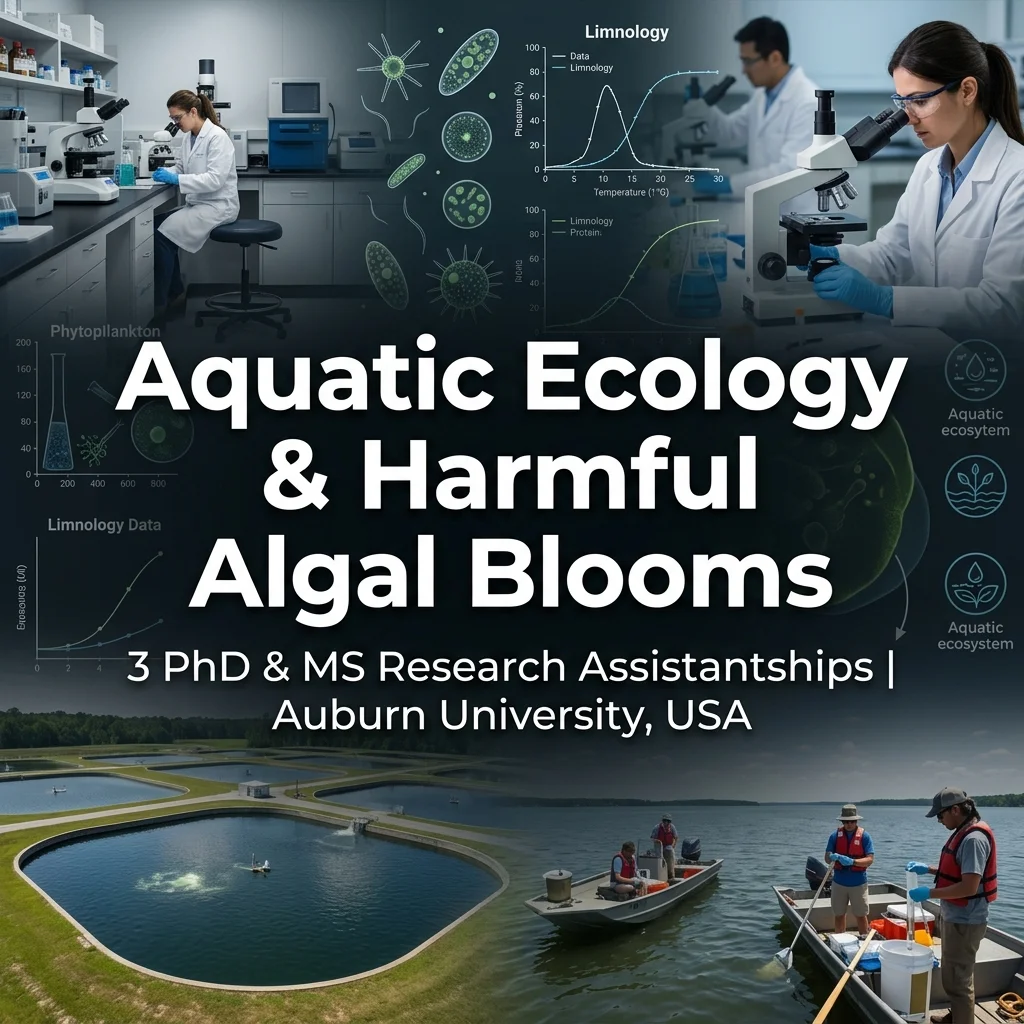
The School of Fisheries, Aquaculture, and Aquatic Sciences at Auburn University in Auburn, Alabama, USA, is seeking applicants for three Graduate Research Assistantships (Ph.D. or M.S. level) in the Wilson Lab.
Research Focus & Aquatic Ecosystem Scope
The Wilson Lab investigates ecological, ecotoxicological, and limnological mechanisms influencing freshwater plankton communities and harmful algal blooms (HABs). Key research areas include:
- Harmful Algal Bloom Dynamics: Unraveling environmental drivers of cyanobacteria and HAB toxicity in drinking water reservoirs and aquaculture systems.
- Aquaculture & Limnology Infrastructure: Utilizing Auburn’s extensive field station featuring hundreds of experimental aquaculture ponds and regional lake monitoring networks.
- Plankton Ecology & Ecotoxicology: Combining field experiments, laboratory analytical chemistry, mathematical modeling, and meta-analyses supported by USDA ARS and USDA NIFA funding.
Assistantship Package & Benefits
- Host Department: School of Fisheries, Aquaculture, and Aquatic Sciences, Auburn University, Alabama, USA.
- Degree Level: Ph.D. (preferred) or M.S. degrees.
- Funding Support: Full graduate research assistantship stipend, tuition waiver, and research project funding.
- Start Date: Spring or Fall academic terms.
Candidate Requirements
- Bachelor’s or Master’s degree in Fisheries Science, Aquaculture, Limnology, Aquatic Ecology, Environmental Science, or related discipline.
- Interest in freshwater plankton communities, field sampling, and quantitative ecological modeling.
- Strong academic writing and analytical capabilities.
How to Apply
Interested candidates should email Dr. Alan Wilson directly with a cover letter outlining research interests, CV, unofficial transcripts, and GRE scores (if available). Full application instructions are available on the Wilson Lab website.